





 ACCOUNT



Plum mania - or why plum oil is so extraordinary
Contents
- Plum seed oil - in a nutshell
- The European plum
- Plum oil in the kitchen?
- The smell of plum oil
- Amygdalin and other compounds
- The criminal scent of almonds
- Benzaldehyde
- No need to worry :)
- The method of pressing plum oil
- The process of obtaining the oil - the "cold" method
- Cold pressed, unrefined, full of fatty acids
- Plum oil in cosmetics
- Plum oil is an emollient
- How to recognise dry skin and how to rescue it?
- Fatty acids and vitamin E in plum seed oil
- A favourite in face and body care
- Dry, rough skin
- Oily and combination skin
- Mature skin, wrinkles
- A versatile soloist
- Any hair enthusiasts here?
- Medium and high porosity hair
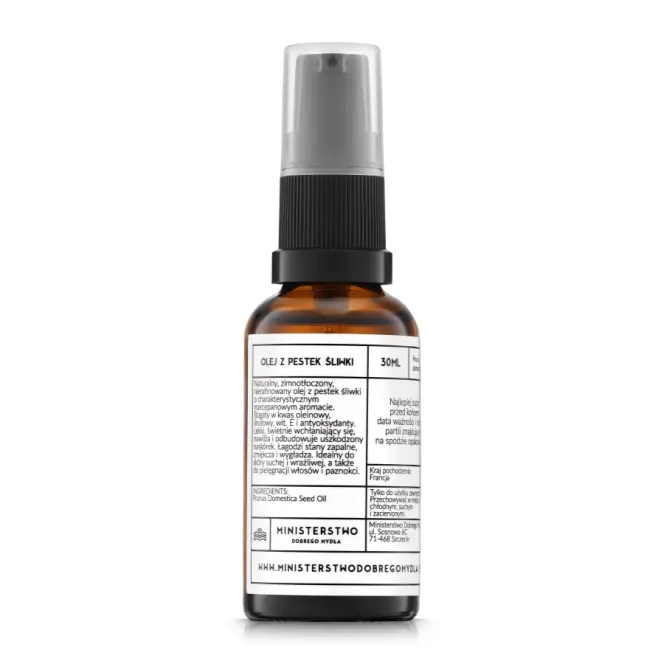
Plum seed oil - in a nutshell
A French, unrefined, "cold" pressed oil from the stones of the common plum, in brown pharmacy glass. Pleasantly golden, smelling of marzipan... Exactly! And that is its natural characteristic, we are not enhancing anything!
Welcome to Plum mania - that is, everything you would like to know about plum oil!
The European plum
Plum trees belong to the rose family - the same family includes cherries, peaches, apples and strawberries :). Plum fruit is filled to the brim with vitamins: A, E, K and those of the B group. They contain minerals beneficial to health, support the digestive system and have a positive effect on the condition of our skin.
Did you know?
Did you know that plums are grown on every continent except Antarctica?
Traces of them have been discovered in the Neolithic era, which means they were just as popular as olives!
Did you know? No. 2
At the end of the 19th century the European plum conquered the United States, and took a particular liking to California for cultivation. In our range that Californian oil reigned at first - now we bring it in from French oil mills.
Plum oil in the kitchen?
We add plums to cakes, cook compotes from them and preserve them as jam. We eat them raw, dried, and they can also be pickled. Prepared that way they work well in Japanese rice balls, so-called "onigiri". We know the uses of plums in traditional cooking well, but oil? Where did the idea of pressing oil from plums even come from? Well, its production began among other places in France, where it was used mainly for culinary purposes. And what is it like? It has a mild, pleasant, nutty taste and a surprising aroma - not fruity, but of almonds and marzipan. It lends an extraordinary smell and taste (especially to salads, cakes and desserts).
The smell of plum oil
What is responsible for the characteristic, captivating almond-marzipan aroma of plum oil? We searched for the answer for a long time, but we have it!
Amygdalin and other compounds
Picking out one single compound responsible for the intense smell of plum oil is quite a challenge. Among the most interesting are: amygdalin, benzaldehyde (which can be isolated from the press cake - what remains after the oil is pressed), and also gamma-decalactone.
A curiosity :)
Amygdalin, produced by the seeds of plants from the rose family, is a complex chemical substance consisting among other things of mandelonitrile. The task of amygdalin is to protect the seeds against herbivorous animals and insects. How? By breaking mandelonitrile down into further components, we obtain cyanide and benzaldehyde - uninvited guests are deterred by the bitter taste of the substance.
The criminal scent of almonds
The characteristic scent of almonds, known among others from the novels of Agatha Christie, has been associated with cyanide. As it turns out, however, not entirely correctly - digging into the subject, we learn that... cyanide has no smell! What is beyond dispute, though, is that in an unbelievably high concentration it is poisonous.
Benzaldehyde
It is exactly the benzaldehyde contained in amygdalin (not cyanide!) that is responsible for the bitter taste of the stones and their characteristic almond smell. Benzaldehyde (otherwise known as benzoic aldehyde) is used in the perfume and food industries, in the production of spices and dyes (it is not toxic!).
No need to worry :)
Plum stones contain a low level of amygdalin, though - the level of cyanide in them is negligible and safe, especially if we focus on external use of the oil. Benzaldehyde itself, however, has such an intense smell that it is noticeable even at a low concentration.
The method of pressing plum oil
The process of obtaining the oil - the "cold" method
The plum is a stone fruit - that much we know :). In its sweet, fruity flesh the plum hides an endocarp - which is another name for the stone. The stone in turn surrounds the almond-like plum seed, the so-called kernel/embryo. The stones are separated from the fruit (which we use in the food industry). The stones themselves (with the precious almond inside) are thoroughly dried and then ground, crushed or powdered. Preparing the raw material this way ensures better contact with the press during pressing.
The press squeezes the powdered seeds under high pressure - without the use of heat or chemical agents. This is exactly how we obtain the material we are after - our golden, beautifully scented plum seed oil :).
Cold pressed, unrefined, full of fatty acids
Pressing the oil by the "cold" method yields a raw, natural oil of a light or dark yellow colour, a light consistency and an almond-marzipan aroma. To additionally clean the oil of pressing residue, it is filtered and centrifuged.
Despite this gentle cleaning, a small amount of sediment may still appear at the bottom of the bottle of unrefined plum oil. This is a completely natural situation, though - there is nothing to be afraid of :).
The absence of refining and pressing by the "cold" method allow plum oil to keep its valuable components - vitamins, antioxidants and a wealth of fatty acids.
Did you know?
The cosmetics industry uses not only the oil pressed from the stones :). Finely ground plum stones are used as an abrasive, for example in body scrubs.
Plum oil in cosmetics
Initially used mainly in the culinary industry, it soon after stole the hearts of cosmetics manufacturers. At first other oils were very timidly mixed with it to obtain a pleasant aroma. Today plum seed oil is a wonderful cosmetic raw material for use both on its own and in all kinds of multi-ingredient formulas :). It is used in products for the care of body, face and hair - in creams, lotions, face serums, shampoos, hair conditioners and many, many others. In the ingredient list of a chosen cosmetic product (INCI) you will find plum seed oil under the name: Prunus Domestica Seed Oil. What makes it so exceptional?
Plum oil is an emollient
The task of emollients is above all to soften (from the Latin emolliere, meaning literally "to soften"). Besides this important quality, emollients have a number of others, such as lubricating, preventing the excessive loss of water through the epidermis and protecting the skin from the unfavourable action of external factors.
Factors such as age, lifestyle, unsuitable care and weather conditions are the main ones (or some of many) that affect the working of the skin's protective coat. Its weakening brings with it a whole series of inconveniences, showing up among others as dryness and roughness of the skin, its sensitivity and tendency to irritation and redness.
How to recognise dry skin and how to rescue it?
We notice the signs of ageing sooner, more or less visible wrinkles appear, the skin becomes less firm. It lacks radiance and a healthy complexion - and this is when emollients come to the rescue :). They help restore a proper level of hydration to the skin, protect it and let it stay in good condition for longer.
Fatty acids and vitamin E in plum seed oil
In plum oil we find among others: unsaturated fatty acids (EFAs), saturated fatty acids, vitamin E, beta-carotene and phytosterols.
The high content of unsaturated fatty acids (over 90%) means that plum oil is classed among the light, quickly absorbed oils. It does not leave the skin weighed down and greasy, but silky smooth, with a delicate, healthy glow :).
The largest share, as much as 80% of the composition, is oleic acid, classed among the Omega-9 acids. It creates a delicate occlusive layer (film) on the surface of the skin that prevents excessive water loss from it (so it has an indirectly moisturising effect). It additionally softens the skin and is largely responsible for increasing its elasticity and firmness. Oleic acid also has an antioxidant effect, helping to fend off the action of free radicals. It reduces the visibility of the signs of ageing, soothes dry, chapped skin, redness and irritation. Used in hair care products, it adds shine and tames frizz.
Linoleic acid, classed among the Omega-6 acids, improves and strengthens the lipid barrier of the epidermis, protects against excessive water loss and also regulates the work of the sebaceous glands. It plays an important role in the proper functioning of both dry and oily, blemish-prone skin.
In plum oil we also find palmitic, arachidic, linolenic and stearic acid, which contribute to reducing TEWL (transepidermal water loss), strengthen the skin's lipid barrier and perform protective and conditioning functions for skin, hair and nails.
The high content of natural vitamin E (mainly in the form of alpha and gamma tocopherol) gives plum oil antioxidant and anti-ageing properties and supports skin regeneration. It additionally strengthens the oil's moisturising effect, soothing and bringing relief to dry, flaking and irritated skin.
Plant sterols - phytosterols are a valuable cosmetic ingredient - they strengthen the lipid barrier of the epidermis and hold back water loss. In structure they are close to the sterols present in sebum and in the intercellular cement of the skin - they are well tolerated by the skin, have a softening effect, regenerate and improve the elasticity of the skin, making them a natural weapon against the signs of ageing. In plum oil we find among others beta-sitosterol and delta-5-avenasterol.
Plum oil is therefore an ideal candidate to accompany complexions in need of moisture, nourishment and support in regeneration. It has a beautiful marzipan-almond aroma and is quite versatile, because we can use it in the care of hair, nails, facial skin and the body.
A favourite in face and body care
Dry, rough skin
In the case of dry, chapped, rough skin, plum oil will have a blessed effect on raising its hydration and improving the functioning of the lipid barrier of the epidermis.
- it will create a protective occlusive layer on the surface of the skin,
- it will protect the skin from water evaporation,
- it will soften, leaving the skin pleasantly smooth to the touch.
So the oil can be applied to: elbows, knees, heels, calves (especially during the heating season or after a bath/swimming pool), hands dried out by detergents, and also the cuticles around the nails, chapped lips, facial skin (after dampening it first, for example with a hydrolat, or after mixing it with a portion of cream), and during an aromatherapy massage (of the face or body ;)).
Pro tip for beautiful lips: Rub the oil into your lips and after a moment collect the excess with a cotton pad or a clean cloth. You can also combine a few drops of the oil with finely ground sugar and gently massage your lips with the resulting mixture. A scrub prepared this way will remove dead skin, and the oil in it will leave your lips soft and smooth :).
Oily and combination skin
In the case of oily, acne-prone skin, a drop in linoleic acid is observed in its structure, which translates into blocked pores and the formation of blemishes - the presence of omega-6 acid in plum oil regulates the work of the sebaceous glands, unblocks the pores and reduces the risk of spots forming.
Mature skin, wrinkles
The high content of vitamin E in the oil allows it to be classed as an excellent anti-ageing cosmetic, an indispensable element in the care of mature skin that lacks resilience and radiance. Used on its own or added to your favourite cream it will work like an anti-ageing booster - we recommend giving it a try ;).
A versatile soloist
Plum oil can be the main element of a minimalist routine, replacing a face cream or serum, a cleansing oil for make-up removal, a nail conditioner, a serum for hair ends or a body lotion. Important! We apply oils to damp skin (dampened for example with a hydrolat).
Plum will also do well in the company of your favourite cream or mask - simply add a few drops of the oil to the prepared portion of cream (for example in your hand), mix and then apply to the skin, gently massaging or patting it in. Oil added to a cream will strengthen its moisturising, protective and nourishing action :).
Any hair enthusiasts here?
We are not asking without reason ;). The beneficial properties resulting from the rich acid composition of plum oil place it on the podium among raw materials that strengthen hair and protect it from external factors such as high and low temperatures, wind and UV rays.
Medium and high porosity hair
Dry, brittle, prone to frizz - those are their main features. Because of its high content of EFAs and vitamin E, plum oil is most often used in the care of this type of hair. It keeps hair in good condition, smoothing it and adding shine. It strengthens dry, dull and damaged hair, maintaining the right level of hydration in it.
How to use the oil on hair?
- overnight oiling or oiling for fifteen minutes or so along the whole length,
- protecting the ends before or after styling,
- as an addition to a hair mask/conditioner (it will enrich the product with nourishing and emollient action).
Natural, vegan, unrefined, pressed by the "cold" method (without the use of high temperatures and chemical agents), with an extraordinary, pleasant marzipan aroma. For our plum oil we have obtained the V-label Vegan certificate, confirming its quality and the proper way it is sourced.
It is light, quickly absorbed and does not weigh the skin down, leaving it soft and smooth to the touch. It is considered non-comedogenic (it does not clog pores).
Protective and nourishing, it creates an occlusion (film) on the surface of the skin that reduces the evaporation of water from the epidermis (TEWL) and therefore has a moisturising effect, supports the regeneration of the epidermis and gets rid of the signs of dryness. Water held in the epidermis penetrates deeper into it, sealing the intercellular space - the skin looks healthier and more radiant, is more elastic and smoother.
Plum oil can be used both as the only cosmetic in a minimalist routine, as a booster for favourite creams and conditioners, and as an element of multi-ingredient formulas. It works well in the care of the skin of the face and body, as well as hair and nails.
Welcome!
Products from this article:
- BESTSELLER

 4.9 / 151
4.9 ( 151 RATINGS )
4.9 / 151
4.9 ( 151 RATINGS )

- Out of stock

- BESTSELLER

Similar posts

2026-10-12
Hand Cream Ingredients - What Works and What's Best Avoided?
Your expert guide to the INCI list: discover moisturising, regenerating and protective ingredients, and learn which substances are…
Read more
2026-02-20
What is the skin microbiome and why is it worth caring for its balance?
Did you know that millions of microorganisms live on your skin and look after its health and appearance every single day? This is the skin…
Read more
2025-04-24
Glycation and sugars in cosmetics - why it is better to use a sugar serum than to eat sugar?
Do you know this sweet irony? The sugar that ruins your skin from within can be its greatest ally in cosmetics! Discover the surprising…
Read more