





 ACCOUNT



Why we fell in love with sugarcane squalane
Contents
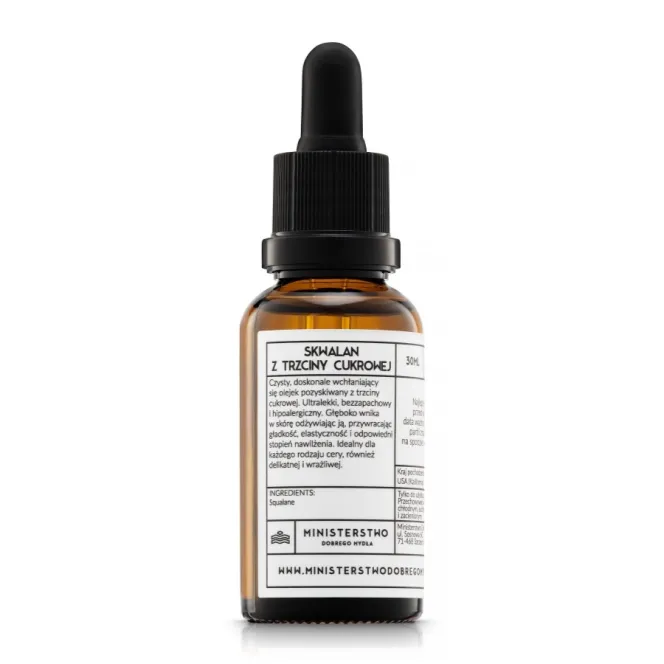
What is squalane?
Squalane is a very pleasant, multifunctional, hypoallergenic and feather-light oil whose most stable and most environmentally friendly form is obtained (relatively recently) from sugarcane. Its small molecules penetrate the epidermis quickly and deeply, nourishing, moisturising and improving the overall appearance of the skin. It is the perfect candidate for your best cosmetic friend :). In this post you will learn a little more about it. Do read on!
Squalane and squalene - what is this all about?
The whole story should begin with what squalene (spelled with an "e") actually is. Our squalane is in fact the plant-based counterpart of squalene, discovered by scientists - a component naturally present in the lipid mantle of the human epidermis.
Squalene - what is it?
Squalene - a colourless, odourless polyunsaturated hydrocarbon - can be found among other places in our sebum, but also in the liver, the heart and the brain. It is one of the main components of human sebum, the protective fatty layer produced by the sebaceous glands distributed across the entire surface of our body (on the skin of the face, the head and the intimate areas, among others), apart from the palms and the soles. Sebum produced by the sebaceous glands gives our skin softness and elasticity, protecting it from the adverse effects of the external environment (bacteria and fungi among others) and preventing excessive evaporation of water. A drop in the level of squalene in the epidermis is a natural process that comes with age - the skin then becomes less firm and elastic, loses its glow and turns dull. Young skin, too, can be irritated, damaged or dried out, and at such times it will not complain about extra support from the outside, delivered in the form of nourishing ingredients that support its natural protective layer. So a substance was sought that could supplement our natural lipid mantle, and it was found... in a rather unfortunate place.
It will come as no surprise to you when we say that the name of this ingredient comes from the word Squalus - a genus of dogfish sharks. It was in shark livers that incredible amounts of it were found (up to 85%). By comparison, squalene can also be found in olive oil, but at a concentration of only around 0.7%. Wonderful but capricious (because it is unstable outside the body), squalene was quickly tamed by saturating all its double bonds, and thus... squalane was born! As the next wonder ingredient, squalane quickly repeated the story of its predecessors - obtained from living animals, it led to the species being decimated to such an extent that in 2013 a campaign was carried out to force cosmetics manufacturers to declare the origin of the squalane used in production. Attempts were made (with considerable success) to push the cosmetics industry to give up squalane derived from squalene obtained from shark liver in favour of the olive version or the one extracted from amaranth seeds. It took scientists years, however, to develop a method of effectively obtaining squalane in laboratory conditions.
In order to supplement this valuable ingredient without harming sharks, ways were sought to obtain it from plants. Initially the main source of squalane was the olive tree mentioned earlier. To this day you will find this ingredient on the market obtained from olive oil. It is a colourless, feather-light oil used in cosmetics in all sorts of ways. It does happen, though, that it is more or less contaminated with components coming from the processed raw material. "Extracting" squalane from olive oil is also not the most efficient way of obtaining it. It took scientists years to develop a method of effectively producing squalane in laboratory conditions. In their search for better solutions they finally made a revolutionary discovery: stable and beautifully pure squalane can also be obtained from fermented sugars! Thanks to this, today squalane can be obtained sustainably and renewably from sugarcane, and that is exactly the one you will find in Ministerstwo's range :).
Sugarcane squalane - how is it made?
Sugarcane squalane is produced from the waste left over after sugarcane has been used to make sugar. The sugars from the cane are fermented with genetically modified, non-pathogenic strains of the yeast Saccharomyces cerevisiae. In a very clever, multi-stage chemical transformation, a stable, transparent and odourless form of a super-light oil is created which retains the properties of the original squalene (and the yeasts are politely shown out of the party ;)). This is how a high-quality ingredient is made that appeared on the market as early as the 1950s and conquered the cosmetics industry in no time. You will find it in small amounts in creams, lotions and oil formulas, as well as in lip balms, hair conditioners and even in colour cosmetics.
Sugarcane squalane is produced in a renewable and sustainable way that saves the lives of thousands of sharks.
Our love for squalane
We met at a cosmetic raw materials fair almost a decade ago. By chance, walking past, quite unexpectedly. It was different from all the others, intriguing ;). Back then the olive version still reigned, and it was the one that went into the formula of our plum scrub. Only later did ours, the sugarcane one, join it. We fell in love with it from the very first rub. It was a time when heavier oil forms dominated the natural ingredients market, and among the light ones the most popular was mainly Caprylic/Capric Triglyceride - a coconut-derived emollient, but not the lightest one either. And then suddenly a revelation - maybe not quite a substitute for silicones, because let us be honest, almost everyone is looking for silicone sensoriality (though not everyone is aware of it or admits it ;)), but almost, almost there!
Squalane perfectly completed the formula of our balm sticks and the plum scrub, which we finally liked once it was added! The crush was so strong that, besides adding it to our formulas, we decided to serve it to you undiluted as well - 100% wonder in a bottle with a pipette ;). And to keep the standard high we chose the EcoCert-certified version, and took care of the Vlabel Vegan certification on top of that ourselves. The certificates confirm the quality and the highest purity of the raw material, as well as the proper way it is obtained.
How to use sugarcane squalane?
Besides using squalane on its own (remembering always to apply the oil to slightly dampened skin), you can also reach for it when winter comes and our favourite cream turns out to be too light - just add a drop of squalane to it before application and there is no need to go shopping for yet another cream. When we struggle with dry, breaking or split hair ends, we apply squalane to them (on damp or dry hair) half an hour before washing and wrap it all in a nice warm towel. It is similar with a dry, irritated scalp - we gently massage squalane into the scalp half an hour before washing it, and then wash the hair with a mild shampoo. Dry, brittle nails? A daily evening squalane rub into the nail plate and the surrounding cuticles should be perfect!
How sugarcane squalane works in cosmetics
As a light, fast-absorbing oil that does not weigh the skin down, squalane can be used under make-up and works well in the care of every skin type, including dry, sensitive, mature and tired skin, as well as skin prone to irritation, allergies, eczema or psoriasis. Normal, oily, problem and acne-prone skin will also benefit from its beneficial properties.
- squalane does not irritate the skin, does not dry it out and does not cause a feeling of tightness (it should be applied to skin dampened beforehand, for example with a hydrolate),
- it brightens the skin and gives it a healthy glow, improving the look of dull and tired skin,
- it reduces roughness, restoring smoothness to the skin,
- it leaves the skin soft to the touch, giving it a velvety finish,
- it intensively moisturises, nourishes, soothes and calms,
- it prevents the skin from looking shiny, does not clog pores, reduces the number and visibility of imperfections and regulates sebum production - good news for oily skin :),
- it reduces fine wrinkles, restores elasticity and firmness to the skin and gently tightens it,
- it protects the skin from the adverse effects of environmental and weather factors.
In which Ministerstwo products will you find sugarcane squalane?
- Lip balm-mask - Honey
- Lip scrub - Honey
- Face serum - Rice + Ceramides
- Face serum - Rose-Raspberry
- Eye serum - Rose-Raspberry
- Face cream - Rose-Raspberry
- Face cream - H2O
- Cleansing oil - Rose-Raspberry
- Solid body balm - Saffron
- Body balm stick - Choco-Cinnamon
- Body balm stick - Banana
- Beard oil - Green Tea
- Face scrub - Halva
- Shampoo bar - Milk-Honey-Oat
- Shampoo bar - Green Tea
Products from this article:

 5.0 / 108
5.0 ( 108 RATINGS )
5.0 / 108
5.0 ( 108 RATINGS )

Similar posts

2026-10-12
Hand Cream Ingredients - What Works and What's Best Avoided?
Your expert guide to the INCI list: discover moisturising, regenerating and protective ingredients, and learn which substances are…
Read more
2026-02-20
What is the skin microbiome and why is it worth caring for its balance?
Did you know that millions of microorganisms live on your skin and look after its health and appearance every single day? This is the skin…
Read more
2025-04-24
Glycation and sugars in cosmetics - why it is better to use a sugar serum than to eat sugar?
Do you know this sweet irony? The sugar that ruins your skin from within can be its greatest ally in cosmetics! Discover the surprising…
Read more