





 ACCOUNT



Sheaology - everything you want to know about shea butter!
Contents
It literally means (in our own words ;)) "the science of shea"
We invite you to an extraordinary story about a cosmetic classic, a remarkable raw material, the Gold of Africa.
What is shea butter - in a nutshell
Shea is a plant oil obtained from the fruit of an African tree called (you will soon find out why ;)) the Park's shea tree. In its fresh, unprocessed form it has a creamy colour and a hard, compact, butter-like consistency. It is a stable fat, resistant to rancidity. Despite its seemingly awkward, rather hard consistency, once warmed briefly in the hands and in contact with the skin shea turns into a liquid, pleasant, nourishing oil. To make application a little easier, shea can be warmed in a water bath (doing it very slowly - so as not to burn yourself - gradually raising the temperature of the butter to a maximum of 80 degrees Celsius, because a higher temperature causes this raw material to lose its wonderful care properties).
PS: Please also remember not to add water to the butter on your own (that takes us into the realm of water-fat mixtures, which have to be properly preserved so they can be used safely in skincare ;)).
Because shea butter melts at just 30 degrees, applying it is definitely more convenient in summer - shea is softer then, easier to scoop up and melts in the hands even faster. But! In all seriousness, shea is great whatever the weather :)
So we will try to present you with its enormous number of virtues. Welcome!
What is shea butter? Where does it come from, how is it made and why is it so remarkable?
A few curiosities about shea butter to begin with!
Thanks to its versatile care properties, shea butter has gained huge popularity among cosmetics manufacturers, and that popularity seems to grow with every year. It is also used in gastronomy, though - it goes into luxury chocolates and margarines (yes, it is edible!). But back to cosmetics (because that is what we do professionally, let us leave the food to those better than us ;)) - shea butter goes into nourishing body lotions and creams, face care products, hair conditioners and shampoos, lipsticks, soaps and many, maaany others. Shea moisturises, smooths, soothes, strengthens, firms, softens, protects, does not cause allergies... It is magic! In the International Nomenclature of Cosmetic Ingredients (INCI) you will find it under the name Butyrospermum Parkii Butter. Who among you has spotted this ingredient in the "Ingredients" list of their favourite lotion, body butter or cream? We are certainly not the only ones :).
FUN FACT!
Shea butter was already known in ancient times! Even before our era the great Egyptian queens - Cleopatra, Nefertiti and Makeda - used shea to care for their bodies and hair, protecting them from the scorching desert sun.
About the man who introduced shea to Europe
In the 18th century the Scottish traveller and explorer of the African continent Mungo Park described in his journals, during his first expeditions to West Africa, a wild-growing, long-lived tree whose uniqueness he then presented to Europeans. In his honour the tree and the raw material obtained from it received the Latin name we know and use today: Butyrospermum Parkii [from the Latin butyro - butter, spermum - seed, and Parkii - as you can easily guess by now - comes from the traveller's surname ;)].
"Shea" - s'i - in the Bambara language means sacred
The tree described by Park has been considered sacred for hundreds of years (mainly because of its longevity - it lives up to 300 years!) and is revered by numerous African tribes who draw on the extraordinary properties of its fruit and seeds.
"Karité" - ghariti in the Wolof language means life
The names "Shea" and "Karité" are used interchangeably. Shea is the English spelling. It comes from the word s'i', used among others by the people of Mali, Burkina Faso and the Ivory Coast. Karité, on the other hand, is the French spelling, derived from the word ghariti. In Senegal, Gambia and Mauritania shea trees are known as trees of life.
Butter trees - Park's shea trees
Butter trees grow in 19 countries of western and central Africa. These include Burkina Faso, Benin, Ghana, Ethiopia, Mali, the Ivory Coast, Nigeria, Senegal, Uganda and Sudan. The area stretching south of the Sahara is called the Shea Belt. Nigeria, Ghana and Uganda are famous for the very high quality of the raw material obtained from shea trees. Because of where they grow, two subspecies of these trees are distinguished - in botanical nomenclature they are: Vitellaria Paradoxa (growing in West Africa) and Vitellaria Nilotica (found in East Africa). They are similar to each other, but the butter obtained from them has slightly different properties, which we will mention a little later. Shea trees are subject to special protection because the species is threatened with extinction. These trees have a huge impact on the local economy - they enrich the soil (grain is often sown around them), give shade, their fruit is a source of fat-rich food, and the oil obtained from the seeds is an extremely valuable export product. Despite all efforts, it has not been possible so far to "domesticate" shea trees and start growing them on plantations. Shea trees take a long time to mature enough to bear fruit (the first harvest is possible only after a dozen or more years), and their needs and requirements (which would make larger-scale cultivation possible) still remain a mystery. Shea trees grow alone, rarely found in groups. They reach up to 25 metres in height. They have leathery leaves clustered at the ends of the twigs, elongated and oval in shape, covered with fine down underneath. Quite remarkably, they bloom in the dry season, and their flowers are small and creamy in colour. A shea tree bears fruit every 2-3 years, and the plum-like, yellow-green fruits appear only on 15-20 year old trees, at the beginning of the rainy season. As we mentioned, the fruit of the butter tree is edible, and inside it sits a large, incredibly valuable, reddish-brown seed. It is from this seed that shea butter is obtained.
The fruit of the shea tree
Round, sometimes elongated, light green, occasionally turning yellowish, plum-sized fruit - that is the short description of shea tree fruit. Let us look inside the fruit, though, under its smooth, juicy green skin :). Beneath the skin there is a thin layer of slightly firm flesh which - as the fruit ripens - becomes softer. In consistency it resembles a ripe pear melting in the mouth. It is slightly sweet, with a gently nutty note. The flesh of shea fruit has a very low sugar content. It is rich, on the other hand, in dietary fibre, vitamin C (it contains three times more of it than oranges!), potassium, calcium, phosphorus, magnesium, zinc and other nutrients. Shea fruit also contains a significant amount of phenols (much like green tea), which have antioxidant properties.
Shea butter in the kitchen!
The fruit, or specifically its flesh, can be eaten raw or cooked. It is added to baked goods and used to make jams, jellies and also... wine! The butter made from the kernels, in turn, is used for frying and baking, and treated as a flavour enhancer. We will talk about the process of making shea butter at greater length in the next part. For now we will only say that the production process consists of: boiling, drying, crushing, roasting, grinding, kneading, boiling and filtering. Quite a lot of work, isn't it? :)
Fried in shea butter...
In Bamako, the capital of Mali, doughnuts fried in shea are a delicacy - the butter gives them a distinctive, nutty aroma. The doughnuts are sprinkled with powdered milk and sugar or dipped in milk right before eating.
The Begu ritual - the start of the shea fruit harvest
The first harvest of the year is a great event and is celebrated during a ritual called Begu. It begins with a feast at which dishes made from brown beans are eaten, enriched with shea fruit and shea butter obtained from the first seeds gathered in the new season.
Shea butter - the gold of African women
By tradition, only women and children may take part in the harvest and in the entire process of making the raw material - men may not touch the sacred trees, which are not meant to be felled. The exception are boys who have not yet reached puberty. The fruit takes almost half a year to ripen - the harvest is possible at the earliest around May/June. The fruit is not picked from the trees, which makes the work considerably harder and longer - only the ripe fruit that has fallen to the ground by itself is used. And because shea trees often grow alone, women sometimes walk many kilometres to gather the desired amount of fruit. Depending on the size and age of the tree, as well as the weather conditions in a given season, up to 40 kg of "green gold" can be collected from a single tree, which in turn yields close to 2-3 kg of pure, extremely valuable, unrefined shea butter. Local communities that obtain shea butter in the traditional way use neither high temperatures nor any chemical ingredients in its production. The method of obtaining this raw material, unchanged for hundreds of years, is called the "cold" method.
The process of obtaining shea butter
First the fruit is selected and cleaned - the skin and flesh are removed and it is boiled for about half an hour to get rid of impurities and remains of the outer part of the fruit. The boiled nuts are spread out on the ground and left to dry, preferably in the sun (and since the harvest takes place in the rainy season, proper supervision of this stage is veeery important). Once dry, the shell cracks easily - using a stone or a wooden tool, the women gently tap the nuts, releasing the seed hidden inside. Next, the shells are separated from the seeds, and each seed is carefully checked for quality, which is very time-consuming. The seeds that meet the requirements are washed again, often several times, and... dried ;).
FUN FACT!
Seeds intended for the production of organic shea butter should dry on cement surfaces or special tarpaulins, which prevent the seeds from becoming contaminated.
The selected seeds are then crushed into a coarse flour using a wooden or stone mortar (it is also possible to grind the seeds in special mills, if these are available in a given village, which considerably eases and speeds up the process). The ground seeds are then roasted in rotating ovens. Traditionally, huge pots were used for roasting the seeds - during roasting the women had to stir the seeds constantly, which risked burns - today, thanks to closed ovens, the process is far safer. After roasting, the ground seeds are spread out on a cement surface - they have to cool down and any moisture evaporates. The seeds are then ground again. The result is a sticky, brown paste, to which water is added in the next step. But what is water doing in the process of obtaining a fat? Why is water added to the meticulously dried, roasted and ground shea seeds? The thick, sticky paste created during the second grinding of the kernels will soon be turned by women's hands, in a truly remarkable and admirable way, into a real Cinderella story. So - let the magic happen! The right proportion of water added to the paste makes it possible to obtain the perfect consistency of a mass ready for long whipping. The paste is mixed and whipped by hand, vigorously, with water added from time to time, which helps the particles of the emerging oil combine. It is a very hard and time-consuming stage, yet an absolutely crucial one - at last a light, fluffy mass appears on the surface of the vessel. The resulting creamy mass is then lightly boiled and very precisely filtered to remove any impurities left over from production and excess moisture. This stage cannot be rushed - the quality and shelf life of the finished product depend on it. The mass is strained by hand and left to cool. Here it is at last - unrefined shea butter, made by the traditional method. A raw material rich in fatty acids, compact, of uniform consistency, with a distinctive smell and taste and a delicate, creamy colour. You will agree that the production of this unassuming raw material, so often found in today's cosmetics, is worthy of admiration? All that work and patience repays itself with a truly extraordinary product that makes you fall head over heels and will not let you forget about it for a long time. A very long time. To increase the profitability of the butter and to speed up and simplify its production, large corporations have taken to producing shea with the help of chemical solvents - such a raw material is far from organic, though. It is also hard to find in it the extraordinarily beneficial and versatile properties of the material obtained in the traditional way.
Shea - a wealth of active ingredients
What will we find in shea butter?
- 5 fatty acids
- vitamins
- unsaponifiable fractions
- waxes, allantoin
- phytosterols, catechins, gallic acid, cinnamic acid
and maaany other ingredients!
5 fatty acids
Shea butter is a wealth of unsaturated and saturated fatty acids: oleic, stearic, palmitic, arachidic and linoleic. 90% is a mixture of two of them - oleic and stearic. Their proportion depends on the region the butter comes from and affects its consistency: stearic acid makes shea hard, while oleic acid makes it softer. For example, shea butter from Uganda has a higher share of oleic acid (up to 55%), is softer and can take on a liquid form at room temperature. In shea from Ghana, on the other hand, more than half of the composition is stearic acid - which is why butter from this region (including the ministerial one!) is harder :). Thanks to the high content of saturated and unsaturated fatty acids, shea butter protects against excessive evaporation of water from the epidermis - so it has an indirectly moisturising effect. The acids also improve the elasticity and resilience of the skin. In addition, oleic acid has a softening effect, and stearic acid is responsible for strengthening the skin's lipid barrier. Linoleic acid, in turn, soothes irritation and evens out the complexion.
Vitamins A, E and F...
...as well as unsaponifiable fractions, help keep the skin in good condition and support its regeneration. They help in the fight against the signs of ageing, supporting collagen synthesis and protecting the skin. They soften and soothe irritated, rough, dry and cracked skin. They smooth, nourish and improve the condition of hair and nails.
Allantoin
It has moisturising, soothing properties and stimulates skin regeneration. It moisturises by binding water molecules in the cells of the epidermis, calms, reduces redness and smooths. It is considered hypoallergenic - we find it in products intended for the care of sensitive, dry, irritated and atopic skin, as well as the delicate skin of children.
Phytosterols, catechins...
...as well as gallic and cinnamic acid, have an antioxidant effect - it is to them that shea owes its stability and resistance to rancidity. They soothe and support the regeneration of irritated skin, and also work against ageing - they firm the skin, make it more elastic and get rid of fine lines. Cinnamic acid additionally supports protection against UVB radiation. Phew... that is quite a lot :) Based on the composition discussed above (briefly, we will not bore you with the details ;)), you can see what a versatile raw material shea is - it is used in the care of the body (of adults and children), as well as hair and nails. Natural cosmetics manufacturers all over the world cannot imagine their products without shea butter. Thanks to its rich composition it is exceptionally multifunctional. We use it on its own or together with other raw materials.
Karité butter for everyone - how does it work?
Shea is an emollient
Shea butter is an emollient - from the Latin emolliere, meaning "to soften". The task of emollients, however, is not only to soften, but also to lubricate and moisturise the skin, as well as to help form a protective layer on its surface (so-called occlusion) that prevents excessive water loss. You will probably say that the skin has its own protective coat... That is true! However, as a result of overly aggressive or unsuitable care (for example not matched to weather conditions), it can become weakened. A weakened hydrolipid layer means our skin becomes dry, rough and sensitive, prone to irritation, reddened, itchy, and the signs of ageing (wrinkles, loss of firmness) show on it sooner. To improve its condition, you need proper care, using products that hold water in the epidermis and create a protective coating on the skin's surface - that is, products containing emollients :).
Sensitive and dry skin
In the care of dry skin, shea butter is the perfect choice - thanks to its high content of fatty acids (oleic, linoleic and stearic among others), it seals and strengthens the skin's protective barrier, keeping it in good condition. It creates a delicate occlusion on the surface that prevents excessive evaporation of water from the epidermis, thereby raising the skin's hydration level. So, once warmed in the hands, we massage it into:
- elbows, knees, heels,
- calves (which after the heating season or frequent baths/swimming pool visits usually look like a sun-cracked desert),
- hands dried out by detergents, and the cuticles around the nail plate,
- the skin of babies and children, supporting the delicate lipid coat of young skin.
If needed, shea butter can also be added to a bath, for adults as well as for children and babies. A small piece of karité dropped into warm water will dissolve quickly, wrapping the skin in a pleasant, delicate protective coating. It will soften, nourish and prevent that unpleasant feeling of dry or tight skin.
Irritated, itchy, reddened skin
Vitamins A, E and F, as well as the unsaponifiable fractions of shea butter and allantoin, support the regeneration processes of irritated and itchy skin (freshly tanned skin, as well as growing pregnancy bumps, will feel enormous relief!). Vitamin A additionally helps lighten newly formed stretch marks. Linoleic acid does not stay idle either - it soothes and calms while helping fight discolouration. Staying with pregnancy bumps for a moment (because we are often asked what can be used to care for them ;)), we have to say that (as long as the mum-to-be is not sensitive to the raw material itself) shea really does the job here - it soothes the itching caused by the stretching skin of the belly, makes it more elastic and evens out the complexion, helping to lighten any stretch marks. It can also be used to care for breasts (not nursing a child), swollen feet and calves. So we can gently massage it into:
- growing pregnancy bumps (shea butter works on the surface layers of the skin, it does not penetrate into the umbilical blood), as well as breasts
- tanned, reddened skin (shea calms and soothes swelling, supporting the regeneration processes)
- itchy skin with signs of inflammation (for example with eczema or psoriasis)
Wrinkles, loss of firmness
And here, besides the ingredients already mentioned, we also have catechins and phytosterols, responsible not only for supporting the regeneration processes of the epidermis, but also for improving its firmness. They activate the synthesis of collagen and elastin, which we lose with age, thanks to which the skin becomes more elastic and resilient. So we gently pat it into:
- swollen, tired eyelids
- the corners of the eyes, "attacked" by crow's feet
- bottoms and thighs, prone to stretch marks (but not only ;))
- cracked, chapped lips
- the décolletage and neck
Hair
Shea is better known as a raw material used in body care. Thanks to its natural active substances, however, it also finds its place in hair products. It can be found as an ingredient in conditioners, masks and shampoos, and also (far more rarely) as a solo player in the "hair care" arena. Thanks to its solid form it applies beautifully, and thanks to its fine particles it quickly penetrates the structure of the hair and looks after it along its whole length (right from the roots!). Its rich composition, and above all the high content of saturated and unsaturated fatty acids, means that shea is suitable for the care of both medium and low porosity hair.
Medium porosity hair
Often curly, dry, brittle, prone to frizz. Because it lacks a natural protective layer, the cuticle opens up and the hair loses hydration - it becomes rough and dull. "Medium porosity" hair therefore needs proper nourishment, regeneration, restored hydration, shine and smoothing, bounce and protection of course. Shea, being an emollient, fits this brief perfectly. Used as a mask (on the hair, but also on the scalp), it will protect against the aggressive action of the detergents contained in shampoos. Added to conditioners, in combination with humectants, it will form a delicate protective coating on the surface of the hair (without weighing it down), holding moisture close, thanks to which the hair becomes more hydrated, smoother and full of life. The "shield" created on the hair will also protect it against the unfavourable action of external climatic factors such as wind, sun or water, as well as those resulting from care treatments (hairdryer, curling iron, straightener), making the hair less brittle and prone to frizz.
Low porosity hair
Naturally smooth, light and not very damaged, this hair is in turn susceptible to external factors (such as temperatures that are too high or too low, including during care treatments). It can be weakened by them, so it is worth taking care of it. Thanks to its fine particles, which (as we mentioned earlier) quickly penetrate the structure of the hair, shea adds shine, makes hair more elastic and smooths it, so that it is easier to comb through. By creating an invisible protective film on the surface (a kind of casing), karité butter shields the hair cuticles from damage and splitting - lying more tightly against each other, they make the hair stronger, healthier and shinier. With low porosity hair it is worth applying shea from mid-length down - this way we will not over-grease the scalp, while still protecting and nourishing the ends :).
The scalp
Shea butter also finds a use in scalp care - it strengthens the hair follicles, thanks to which the hair grows stronger and healthier. Massaged into an irritated and dry scalp prone to flaking and inflammation, it will nourish, soothe and restore hydration to the skin. Warmed in the hands, it also finds a use in caring for the scalp of babies and children - it helps soften and remove cradle cap scales.
We must remember, though, that each of us has a different hair porosity and structure - what works for some will not always work the same way for us :). It is worth trying, though, because it may turn out that this unassuming single-ingredient cosmetic is exactly what your hair needed. No more bad hair days please! ;)
Shea - a totally universal cosmetic
As you have had a chance to read, shea butter, as a soloist, is a totally multifunctional cosmetic. We hope we have managed to encourage at least a little those of you who do not know it yet, and if there are any active shealovers present here - to get you even more excited :). In cosmetics it can (among other things ;)) serve as:
- a body, hand and foot lotion,
- a nail conditioner,
- a lip balm,
- a conditioner/mask for hair and scalp,
- a nourishing bath additive,
- a cream for wrinkles around the eyes,
- a revitalising cream for the décolletage and neck,
- a balm for pregnancy bumps.
Unrefined shea butter, karité, or less commonly galam, is rich in beneficial active ingredients that support the regeneration, rebuilding and protection of our skin and hair. It is a foundation of natural care and is often used as a base for making other cosmetics. That does not surprise us at all ;). Unrefined material is characterised by a delicate, creamy, sometimes darker colour and a distinctive smell which (depending on the batch and the region it comes from) is more or less intense.
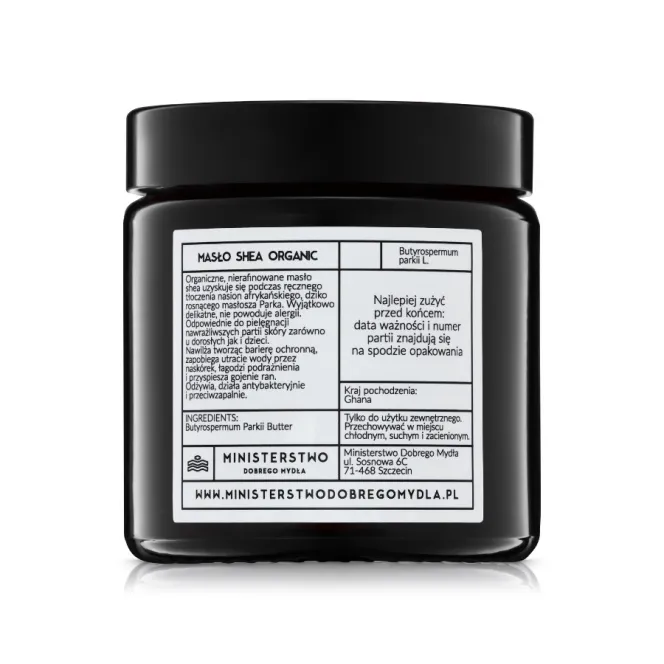
The smell is described in various ways - as buttery, nutty, smoky, sometimes smoked. In the refining process, shea is stripped not only of these two qualities (the colour of refined butter is very light and the smell almost imperceptible), but also of some of the ingredients that are very important for its uniqueness. So if you care about a decisively nourishing effect, it is worth choosing karité butter in the unrefined, organic version, coming from certified cultivation. This way you will be sure of its purity, its production process and the conditions of import - which is extremely important if we have in mind the support of the local communities involved in producing this remarkable raw material. We import our shea butter for you from Ghana. It is produced there by local communities of women who, through its sale, provide an income for their families. It holds the Fair For Life certificate and full organic certification. It comes to us in huge blocks, which we then cut and transfer into glass pharmaceutical jars. We have obtained the European V-label Vegan mark for it.
We invite you to fall in love.
Products from this article:

 4.9 / 67
4.9 ( 67 RATINGS )
4.9 / 67
4.9 ( 67 RATINGS )

Similar posts

2026-10-12
Hand Cream Ingredients - What Works and What's Best Avoided?
Your expert guide to the INCI list: discover moisturising, regenerating and protective ingredients, and learn which substances are…
Read more
2026-02-20
What is the skin microbiome and why is it worth caring for its balance?
Did you know that millions of microorganisms live on your skin and look after its health and appearance every single day? This is the skin…
Read more
2025-04-24
Glycation and sugars in cosmetics - why it is better to use a sugar serum than to eat sugar?
Do you know this sweet irony? The sugar that ruins your skin from within can be its greatest ally in cosmetics! Discover the surprising…
Read more